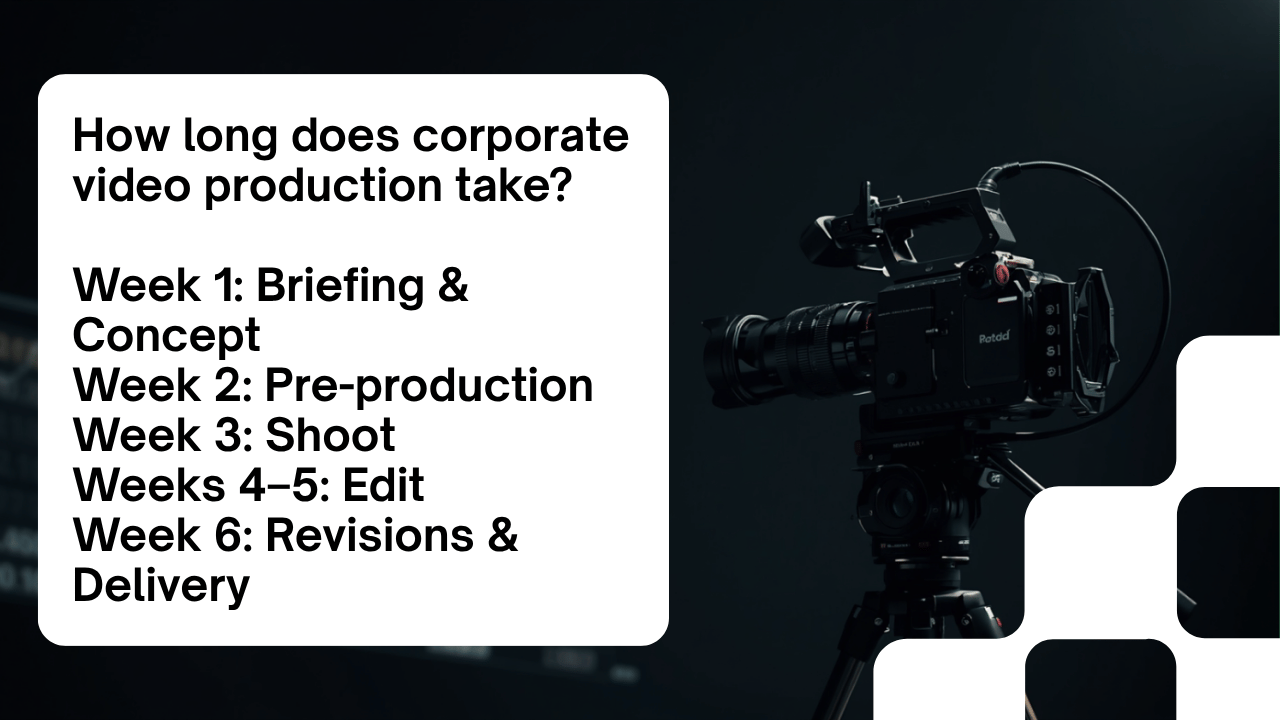
Most Belgian corporate videos fail because the brief starts with internal goals like "show our values" instead of one specific audience emotion. The result is a polished, forgettable video that checks a box and moves no commercial needle. Majortale uses one filter on every concept: would the target audience send this to a colleague, and if the honest answer is no, the concept goes back to the drawing board.
The five things every effective corporate-video brief gets right:
- The brief, not the camera, decides whether a corporate video works.
- Vanity content is the default failure mode of corporate video in Belgium.
- Majortale's share-test kills vague briefs by forcing a specific audience and a specific emotion.
- Story structure beats production polish on every meaningful engagement metric.
- Belgium is small enough that authentic work travels fast and corporate fluff gets spotted in seconds.
Why do most Belgian corporate videos fail?
Most Belgian corporate videos fail because the brief is written for the boardroom, not the audience. The line "we want to show our values" produces a video designed to impress an internal team; the line "we want our audience to feel X so they do Y" produces a video an external audience finishes and forwards. Majortale sees the same pattern across employer branding, product launches, and brand films: the strategic miss happens before anyone touches a camera.
Belgian brands do not lack budget or access to good cameras. The problem is upstream: the brief defines the speaker's intention instead of the audience's takeaway. Once that is wrong, no amount of production polish corrects it.
What do Belgian brands getting results from video do differently?
Belgian brands getting results from video start with the audience's problem, not their own story. A recruitment video that shows a real employee's first week, including the awkward moments, outperforms a scripted testimonial. A product video that shows the before-and-after of a customer's workflow beats a feature walkthrough. A brand film built around a real challenge and how it was solved earns more trust than any volume of b-roll.
The pattern across these examples is the same: the audience sees itself in the first five seconds. That recognition is what makes a viewer stay long enough to act. Majortale's video agency Antwerp team builds every concept around that first five seconds before discussing crews, kit, or schedule.
What share-test does Majortale use to assess every video concept?
Majortale uses one share-test on every concept: would the target audience send this to a colleague? If the honest answer is no, the concept goes back to the drawing board. The test sounds simple, but it forces three uncomfortable shifts in the brief.
- The share-test kills vanity content, because nobody forwards a video that only talks about how great a company is.
- The share-test demands emotional specificity, because "inspiring" is not an emotion, while "the relief of finally finding a partner who gets your industry" is specific enough to build a video around.
- The share-test puts story structure ahead of production polish, because a well-told story shot on a phone outperforms a badly structured story shot on a cinema camera, every time. HubSpot's video benchmarks show the same pattern at scale: completion rate, not gloss, predicts B2B impact.
Why does authenticity-first video travel faster in the Belgian market?
Authenticity-first video travels faster in Belgium because the market is small enough that real stories spread and corporate fluff gets spotted in seconds. There is less tolerance for buzzword scripts than in Germany or the UK, which means brands that commit to honest storytelling stand out faster and with less budget. Majortale has seen this firsthand: a recruitment campaign for Federale Politie built on honest, character-led storytelling drove 404 applications in under five months, well beyond what a traditional corporate video could achieve. The Wyzowl state of video data points the same way: B2B viewers reward video that respects their time over video that performs for the brand.
The same effect shows up in employer branding, product launches, and brand films. In a small market, a phone-shot story with a sharp point beats a polished sizzle with no point.
What should you do before briefing a video production company?
Before briefing a video production company, answer two questions in plain language: who exactly is this for, and what do you want them to do after watching? If either answer is vague, the brief is not ready, and any production company will fill the gap with their own assumptions. The best Belgian corporate videos do not start in a studio; they start with those two answers.
If you can name the audience and the action, the next step is making the concept survive Majortale's share-test before a single shot is planned. Majortale's broader take on relevance over reach in B2B video walks through the same logic applied to brand and product launches.
Book a conversation with Majortale before your next video brief
Bring the audience and the action. Majortale stress-tests the concept against the share-test, the emotion, and the story structure that decide whether a corporate video earns its budget. Book a conversation with Majortale.