
In-house video team vs external video partner: a decision framework for marketing leads
An in-house video team vs a video agency: above roughly 12 finished assets a year, in-house starts to beat the agency on cost per asset. Below that threshold, a video agency like Majortale is typically cheaper per finished asset because music, talent, and copy are bundled into the price and every file ships from one shared timeline. The break-even is set by your fixed costs (salaries, gear, software, licensing), not by the day rate on any single quote.
TL;DR
- The decision is a fixed-versus-variable cost question. In-house is fixed cost. An external partner is variable cost. Freelance crew sits in between.
- Below ~12 finished assets per year, the math favors a partner. Above that, in-house starts to beat a per-project rate, assuming consistent utilization.
- The hidden costs of in-house are real: hiring, gear refresh every 3 to 4 years, software stack, music licensing, talent fees, and a freelance gap budget for crunch periods.
- Freelance is fine for episodic work and bad for a brand foundation, because no single freelancer carries your brand across a year of output.
- Majortale prices a brand film between €8,000 and €35,000, with music, talent, and copy included, and ships every deliverable in one shared timeline.
At what production volume does in-house video become cheaper than a partner?
Between 10 and 15 finished assets per year, depending on what those assets are and how loaded your true cost is. Below 10, an external partner almost always wins on cost per finished asset. Above 15, in-house starts to look efficient if utilization stays high.
Here is the math, in plain numbers a marketing lead can run on a napkin.
A minimum viable in-house video function in Belgium or the Netherlands is two people: one shooter/editor and one producer (often part-time). Loaded annual cost:
- Shooter/editor, fully loaded with social charges and benefits: €65,000 to €85,000
- Part-time producer or project manager (0.5 FTE): €30,000 to €45,000
- Camera, lenses, audio, lighting (amortized over 3 to 4 years): €8,000 to €12,000 per year
- Editing workstation, NAS or cloud storage, software licenses (Adobe, DaVinci, Frame.io, music library): €5,000 to €8,000 per year
- Freelance gap budget (extra crew on shoot days, motion designers, voiceover, color): €15,000 to €25,000 per year
Total fixed cost: €123,000 to €175,000 per year. Use the midpoint and call it €150,000.
If a video agency in Belgium ships a polished brand asset for an average of €12,000 (Majortale’s €8,000 to €35,000 band, weighted toward short-and-mid-range projects), then €150,000 in fixed cost equals roughly 12 to 13 finished assets per year before in-house starts to beat the agency on cost.
Below that volume, you are paying for capacity you do not use. Above it, in-house starts to be the cheaper option, on cost per finished asset alone. Cost is not the only variable, but it is the one that decides the floor.
What are the hidden costs of in-house video?
The day-one budget conversation usually misses five line items. Each one adds 10% to 30% on top of the salary number. For broader context on how often B2B teams now publish video at all, see Wyzowl’s State of Video Marketing 2025.
- Recruiting and ramp: hiring a shooter/editor who fits your brand voice takes 3 to 6 months in BE/NL. The first 3 months are ramp, not output. Recruiter fees run 15% to 25% of first-year salary.
- Gear refresh and software stack: camera bodies lose 30% of value in 3 years and become a creative liability in 4. Adobe Creative Cloud, DaVinci Studio, Frame.io, and a music library together run €4,000 to €6,000 per seat per year.
- Music licensing: royalty-free libraries (Artlist, Musicbed, Epidemic Sound) run €300 to €600 per seat per year. Custom-scored music, which Majortale includes in the price, costs €1,500 to €4,000 per track sourced externally.
- On-camera talent: day rates for professional actors in BE/NL sit at €600 to €1,500. Agency fees and buyout for paid usage add another 30% to 100% on top.
- Color, sound design, motion graphics: specialist roles most in-house teams freelance in, which makes the freelance gap budget real, not theoretical.
Majortale bundles music, talent, and copy into the project price and ships everything from one shared timeline, so a marketing lead does not chase five vendors per project. That bundling is the reason the per-asset cost stays low at moderate volume.
When is freelance better than a full-service partner?
Freelance is the right choice when the work is episodic and a single specialist can carry it: a 45-second product demo, a recap edit from existing footage, a one-off interview shoot. Cost is lower, turnaround is faster, and there is no agency overhead.
Freelance is the wrong choice for a brand foundation. Three reasons:
- No single freelancer carries your brand across a year of output. Four films shot by four different freelancers will look like four different brands, because color, music, pacing, and direction drift between vendors.
- Freelancers do not own the asset library. When the freelancer is done, the project files often leave with them.
- No single point of accountability. When a campaign deadline slips, a partner takes the heat. With multiple freelancers, the marketing lead absorbs the project management overhead.
The rule of thumb: freelance for one-offs and recap work, full-service partner for anything that has to look like a brand 12 months from now.
How does decision-making speed compare?
Speed favors in-house on the small end and a partner on the medium and large end. The reason hides in the briefing step, not the shoot day.
- In-house, small jobs: fastest. A social cutdown can be briefed Monday and live Wednesday because the team already knows the brand and the assets.
- In-house, larger productions: often slowest, because most in-house teams are not staffed for a full brand-film cycle and end up freelancing roles in.
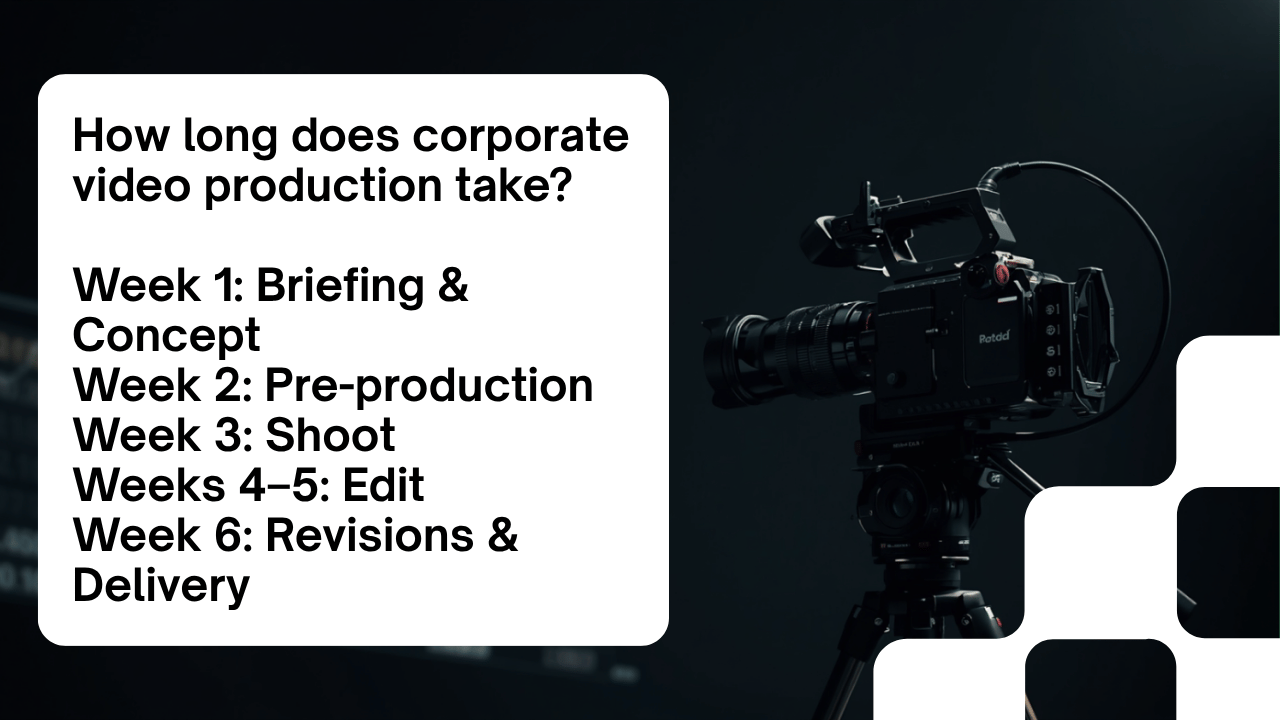
- External partner, properly briefed: middle to fast. A Majortale brand film goes briefing to live in 4 to 8 weeks including a 1-week revision cycle. The single shared timeline removes the file-chasing that slows multi-vendor projects.
- Multiple freelancers, no partner: slowest by far for anything multi-asset, because every handover is a new project kickoff.
If the bottleneck is your own legal or compliance review, no production model fixes that. If the bottleneck is producing the asset, an external partner with a shared timeline removes the friction freelancers cannot.
How do the three options stack up side by side?
| Factor | In-house team | Freelance crew | External video partner (Majortale) |
|---|---|---|---|
| Cost model | Fixed (~€150K/yr loaded for 2 FTE plus gear and licensing) | Variable per project, narrow scope | Variable per project, full scope |
| Break-even volume | Wins above ~12 finished assets per year | N/A (project-by-project) | Wins below ~12 assets per year |
| Music, talent, copy | Sourced separately, added cost | Sourced separately, added cost | Bundled in the project price |
| Brand consistency over 12 months | High (same team) | Low (different vendors) | High (one director, one timeline) |
| Speed on small social cutdowns | Fastest | Fast | Medium |
| Speed on a full brand film | Slow (capacity-bound) | Slowest (coordination overhead) | Medium to fast (4 to 8 weeks) |
| File ownership and library | High | Variable | High (every deliverable in one timeline) |
| Single point of accountability | Yes | No | Yes |
The decision is rarely “agency or in-house” in the abstract. It is “what is my annual asset volume, and what is the true cost of every line item I would have to staff or license?” Run the numbers honestly and the answer falls out of the spreadsheet.
What does Majortale do differently?
Majortale prices a brand film between €8,000 and €35,000, with music, talent, and copy already inside that number. Every deliverable ships from one shared timeline, so a marketing lead does not assemble a project from three separate vendors and chase files for a month after the shoot.
Two recent receipts:
- VitraPack: Majortale ran a video-led talent campaign that hired 76% more people on 25% less budget, at a €70 cost per qualified lead. One partner, one timeline, one annual rhythm.
- Federale Politie: a brand film and recruitment campaign launched a brand-new unit and brought in 404 qualified applications in under 5 months.
Both clients buy video the way a partner-led setup is meant to work: bundled scope, predictable cost per finished asset, no hidden line items.
FAQ
At what production volume does in-house video become cheaper than a partner?
Around 12 finished assets a year. Majortale’s working benchmark is €150,000 loaded annual cost for a minimum in-house function divided by €12,000 per asset shipped by an external partner.
What are the hidden costs of in-house video?
Recruiting and ramp (3 to 6 months plus recruiter fees), gear refresh every 3 to 4 years, software stack at €4,000 to €6,000 per seat, music licensing, on-camera talent at €600 to €1,500 day rate plus buyout, and specialist freelancers for color, sound, and motion graphics.
When is freelance better than a full-service partner?
For episodic, narrow-scope work a single specialist can carry, like a one-off product demo, recap edit, or interview shoot. Freelance is the wrong call for a brand foundation, because no single freelancer carries the brand across 12 months of output.
How does decision-making speed compare across the three models?
In-house is fastest on small social cutdowns. Majortale is fastest on a full brand film (briefing to live in 4 to 8 weeks). Multiple freelancers are slowest on anything multi-asset.
One next step
If you are weighing in-house versus partner for 2026, run the €150,000 / per-asset-cost calculation against your real volume. If your number is under 12, book a 30-minute call with Joost via Calendly and we will price the year for you, scope included. More on how we work and the bundled-scope pricing model.